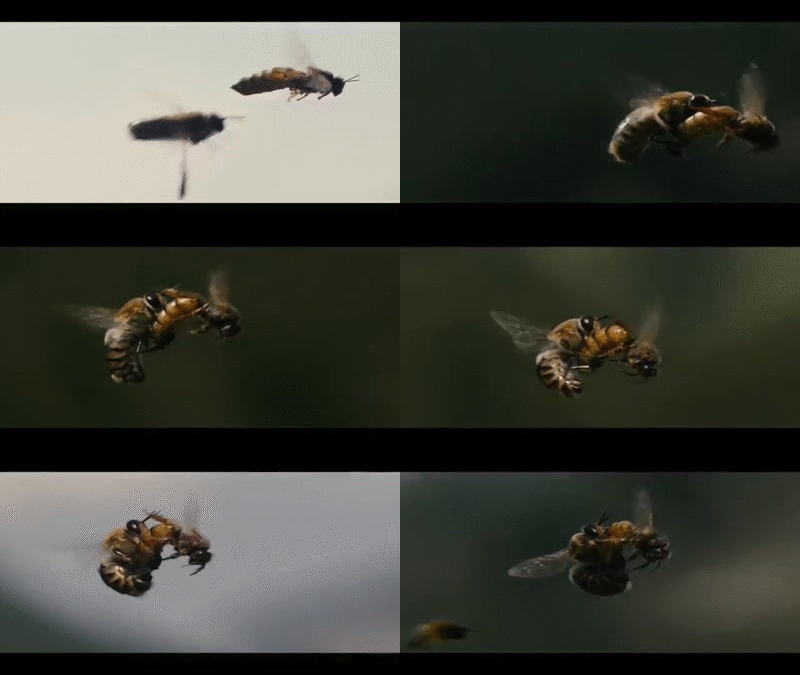
Raising drones: Why males are just as important as queens

► Read for you
To successfully raise queens, it’s not enough to produce high-quality queen cells: the quality of the drones is just as important. This article summarizes what we know about their development, sexual maturity, the impact of Varroa mites, and the limitations of controlling fertilization in open-hive systems.
1. Key points
- Varroa can reduce the reproductive quality of drones, mainly through sperm production and, in cases of heavy infestation, flight capacity.
- A drone takes about 24 days to emerge, and then needs additional time to reach sufficient sexual maturity.
- Rearing drones requires strong, well-fed colonies with low varroa infestation.
- In an open apiary, the genetics of the available drones can be influenced, but matings cannot be fully controlled.
- Drone brood removal reduces varroa, but its effects on local drone availability are poorly quantified.
2. What the study shows
 |
This chapter summarises the document’s central message: a successful mating depends not only on the queen, but also on the availability, age, health and quality of the drones. |
Question. William Seyfarth’s document deals with drone rearing in the honey bee (Apis mellifera): how a drone develops, when it becomes useful for mating, how to manage a drone colony, and why varroa can compromise its reproductive value (Seyfarth, n. d.). It is not a strictly experimental scientific paper, but a technical and educational document for breeding apiculture.
Method. The author offers a practical synthesis in several parts: the drone’s biological cycle, morphology, genetic basis, management of a drone colony, rearing for a mating apiary, mating station or instrumental insemination, and the influence of varroa on drones. The last part of the PDF also contains a chapter on bumblebees of the genus Bombus, but it is distinct from the main topic and is not used here as a practical basis for the apiary.
Results. The document first recalls that the drone hatches from an unfertilised egg laid in a drone cell. Its development until emergence takes about 24 days: egg, larva, pupa, then adult. The author specifies that this duration can lengthen by a few days when food or thermal conditions are unfavourable (Seyfarth, n. d.). After emergence, drones make their first flights between the fifth and the eighth day, then begin to join drone congregation areas later on. Sexual maturity is presented as being reached around the twelfth to fifteenth day after emergence, that is to say roughly forty days after the egg was laid.
On the genetic side, the document highlights a point often underestimated by beekeepers: the drone is haploid. It carries only one set of chromosomes, transmitted by its mother. In practice, this means that a colony selected to produce drones directly disseminates, through its drones, part of the maternal genetics into future matings.
For managing a drone colony, the author insists on three conditions: use strong and healthy colonies, ensure abundant nurse bees, and never let the colonies run short of honey or pollen. He also stresses the importance of a low level of varroa infestation. The drone frame is presented as a practical tool: it allows drone brood production to be triggered and monitored, but it can also become a critical point if varroa multiplies strongly there.
The document then distinguishes three situations. In an ordinary mating apiary, the beekeeper can increase the presence of drones from selected colonies, but matings remain open: drone congregation areas gather drones from many different colonies. In an isolated mating station, control is stronger, provided that isolation is real and that the drones come from selected sister colonies. For instrumental insemination, the document recalls that the origin of the drones must be guaranteed, since drones drift easily from one colony to another.
Interpretation. The practical message is clear: queen rearing should never be considered without drone rearing. A well-reared queen mated by too few drones, by immature drones or by weakened drones will yield a more uncertain result. For Swiss or temperate-European apiaries, the principle is transferable: anticipate drone production, preserve high-quality drone colonies and integrate varroa into the planning. By contrast, the detailed protocols for feeding, queenlessness or station management should not be adopted mechanically without adaptation to the local context, the station’s rules and the prevailing health recommendations.
3. A critical look
 |
This chapter distinguishes what the document genuinely contributes, what remains weakly supported, and what it does not allow one to conclude for beekeeping practice in Switzerland. |
The main strength of the document is pedagogical. It puts drones back at the centre of reproduction, whereas beekeeping practice often talks far more about queens than about males. It also provides a useful benchmark: to have fertile drones at the right moment, planning must start several weeks in advance, not on the day the queen cells are ready.
The document is also useful because it links biology, rearing and varroa. This connection matters: producing a great deal of drone brood in a heavily infested colony can offer varroa a favourable compartment while reducing the reproductive quality of the drones. Conversely, systematically suppressing all drone brood may be coherent within a varroa-reduction strategy, but becomes contradictory if one also wants to produce high-quality drones locally for mating.
The main limitation concerns scientific traceability. The PDF does not provide, in the body of the text, a complete bibliography linking each figure to a specific publication. This is particularly important for the table on the effect of varroa on sperm production and flight performance: the orders of magnitude are plausible and close to published work, but the exact values must be verified before being adopted as reference figures.
Several statements should therefore remain cautious. The number of drones needed to mate a queen, the size of drone congregation areas, the fidelity of drones to a given area, or the volume of sperm that can be collected vary across studies, methods and contexts. They should be used as practical guideposts, not as universal thresholds.
Context must also be discussed. The document mentions practices such as feeding with a honey-water mixture, the use of protein patties, queenlessness in drone colonies or the retention of late-season drones. These techniques may make sense in a specialised rearing setup, but they do not constitute general recommendations for every apiary. In Switzerland, the use of veterinary medicines against varroa must respect the authorised products and their official instructions for use. Likewise, feeding colonies with honey must be assessed cautiously because of disease and robbing risks.
Finally, the document does not demonstrate that an individual beekeeper can control the genetics of matings in an open apiary. They can increase the probability that selected drones will participate in matings, but drone congregation areas remain places of mixing. For real control of the paternal line, one must rely on an organised mating station, a credible isolation arrangement, or instrumental insemination.
4. What related studies show
 |
Related studies confirm that drone quality depends on age, nutrition, season, brood temperature and parasite pressure. But they also show that several links remain indirect or insufficiently measured under field conditions. |
Direct support: varroa reduces the reproductive quality of drones. The study most directly linked to the varroa chapter is Duay, De Jong and Engels (2002). The authors compared drones that were unparasitised, parasitised by one Varroa destructor female, or parasitised by two females during pupal development. Drones parasitised by one or two varroa females produced 24 % and 45 % fewer spermatozoa, respectively, than unparasitised drones. Flight performance was not significantly reduced with a single varroa female, but it dropped sharply in drones parasitised by two females. This study therefore clearly supports the document’s practical message: a heavily infested drone colony is not a good rearing basis.
This conclusion must, however, remain precise. Duay et al. (2002) measure sperm production and flight duration in an experimental setup. They do not directly demonstrate that these drones mate queens less often at congregation areas, or that queens store fewer spermatozoa after mating with parasitised drones. The link with actual mating success is therefore plausible but still partially indirect.
Physiological support: drone age matters. Seyfarth’s document indicates that drones become mature about 12 to 15 days after emergence. Recent studies invite a slightly broader formulation. The review by Rangel and Fisher (2019) places drone sexual maturation in a variable window, depending on age, season, nutrition and rearing conditions. Metz and Tarpy (2019) show that the number of viable spermatozoa in the seminal vesicles is zero at emergence and reaches an average maximum at around 20 days of adult life. Rhodes et al. (2011) also find effects of age, season and genetics on sperm production. For practical purposes, it is therefore better to remember that drones must be available before the queens’ mating flights, and that a window of about two to three weeks after emergence is safer than an overly tight calculation.
Morphological support: not all drones are equal. Schlüns et al. (2003) show that the number of spermatozoa depends on the body size of the drones: larger drones produce more spermatozoa than smaller ones. This study does not focus directly on varroa, but it reinforces an important point: the quality of a drone cannot be reduced to its mere presence in the colony. Size, physiological state, larval development and rearing conditions can all alter its reproductive value.
Ecological support: drone congregation areas mix origins. Studies on drone congregation areas show that queens mate in zones where drones from many colonies gather. Baudry et al. (1998), in Germany, demonstrated high genetic diversity at a drone congregation area. Koeniger, Koeniger and Pechhacker (2005) indicate that drones may prefer nearby areas, but congregation areas remain places of mixing. Mortensen and Ellis (2016), in a very different context with European-derived and Africanised colonies, show that a strong presence of managed colonies can influence the composition of drones at nearby areas. For the Swiss or temperate-European apiary, the message is cautious: one can increase the influence of one’s drone colonies, but matings cannot be fully controlled in an open apiary.
Note on drone brood removal. The work of Charrière et al. (2003), Calderone (2005) and other studies confirms that removing capped drone brood can reduce varroa pressure when integrated into a comprehensive control strategy. But the literature mainly measures the effect on varroa, colony strength or honey production. It measures much less the effect on local drone availability, sperm quality or mating success of queens. Wantuch and Tarpy (2009) even proposed a modified method aimed at controlling varroa while retaining adult drones, which shows that the trade-off between varroa eradication and drone availability is real.
In summary. The other studies confirm the document’s central idea: to obtain successful matings, one needs numerous, mature, well-fed drones that are little affected by varroa or other stressors. But they warn against two simplifications: believing that an open apiary allows full control over paternity, or applying drone brood removal without considering the queen-rearing context.
5. Take-aways for the apiary
 |
In the apiary, the goal is not to produce drones at any price, but to have, at the right moment, mature, healthy drones from colonies one actually wishes to propagate. |
- Plan with margin. A drone takes about 24 days to emerge, but its full reproductive value comes later. For queen rearing, aiming for drones aged around two to three weeks at the time of mating flights is more cautious than an overly tight schedule.
- Choose the drone colonies. Do not let any colony produce the apiary’s drones. Drone colonies should be strong, calm, healthy and well-fed, with a good pollen supply and a low level of varroa infestation.
- Integrate varroa into drone rearing. Varroa readily reproduces in drone brood and can reduce the reproductive quality of drones. A drone colony is therefore not a sanitary no man’s land: it must be part of the apiary’s varroa management concept.
- Adapt drone brood removal to the goal pursued. Drone brood removal can be useful against varroa, but it must be modulated when queens are also being reared. In a breeding apiary, a distinction should be made between colonies used as varroa traps and colonies selected to produce high-quality drones.
- Stay modest about natural mating. In an open apiary, one can increase the proportion of desired drones in the environment, but not guarantee paternity. For genuine genetic control, a well-isolated mating station, a recognised collective arrangement or instrumental insemination is required.
See also:
- All about the drone
- Drone rearing
- Drone frame
- Practical Guide: 1.4.1 Drone brood removal
- Single-drone insemination: an update on the practice
Bibliography
Baudry, E., Solignac, M., Garnery, L., Gries, M., Cornuet, J.-M., & Koeniger, N. (1998). Relatedness among honeybees (Apis mellifera) of a drone congregation. Proceedings of the Royal Society of London. Series B: Biological Sciences, 265, 2009–2014. https://doi.org/10.1098/rspb.1998.0533
Calderone, N. W. (2005). Evaluation of drone brood removal for management of Varroa destructor in colonies of Apis mellifera. Journal of Economic Entomology, 98(3), 645–650. https://doi.org/10.1603/0022-0493-98.3.645
Charrière, J.-D., Imdorf, A., Bachofen, B., & Tschan, A. (2003). The removal of capped drone brood: An effective means of reducing the infestation of varroa in honey bee colonies. Bee World, 84(3), 117–124. https://doi.org/10.1080/0005772X.2003.11099587
Duay, P., De Jong, D., & Engels, W. (2002). Decreased flight performance and sperm production in drones of the honey bee (Apis mellifera) slightly infested by Varroa destructor mites during pupal development. Genetics and Molecular Research, 1(3), 227–232.
Koeniger, N., Koeniger, G., & Pechhacker, H. (2005). The nearer the better? Drones (Apis mellifera) prefer nearer drone congregation areas. Insectes Sociaux, 52, 31–35. https://doi.org/10.1007/s00040-004-0763-z
Metz, B. N., & Tarpy, D. R. (2019). Reproductive senescence in drones of the honey bee (Apis mellifera). Insects, 10(1), 11. https://doi.org/10.3390/insects10010011
Mortensen, A. N., & Ellis, J. D. (2016). Managed European-derived honey bee, Apis mellifera sspp., colonies reduce African-matriline honey bee, A. m. scutellata, drones at regional mating congregations. PLoS ONE, 11(8), e0161331. https://doi.org/10.1371/journal.pone.0161331
Rhodes, J. W., Harden, S., Spooner-Hart, R., Anderson, D. L., & Wheen, G. (2011). Effects of age, season and genetics on semen and sperm production in Apis mellifera drones. Apidologie, 42, 29–38. https://doi.org/10.1051/apido/2010026
Schlüns, H., Schlüns, E. A., van Praagh, J., & Moritz, R. F. A. (2003). Sperm numbers in drone honeybees (Apis mellifera) depend on body size. Apidologie, 34, 577–584. https://doi.org/10.1051/apido:2003051
Wantuch, H. A., & Tarpy, D. R. (2009). Removal of drone brood from Apis mellifera colonies to control Varroa destructor and retain adult drones. Journal of Economic Entomology, 102(6), 2033–2040. https://doi.org/10.1603/029.102.0603