No sex, no problem

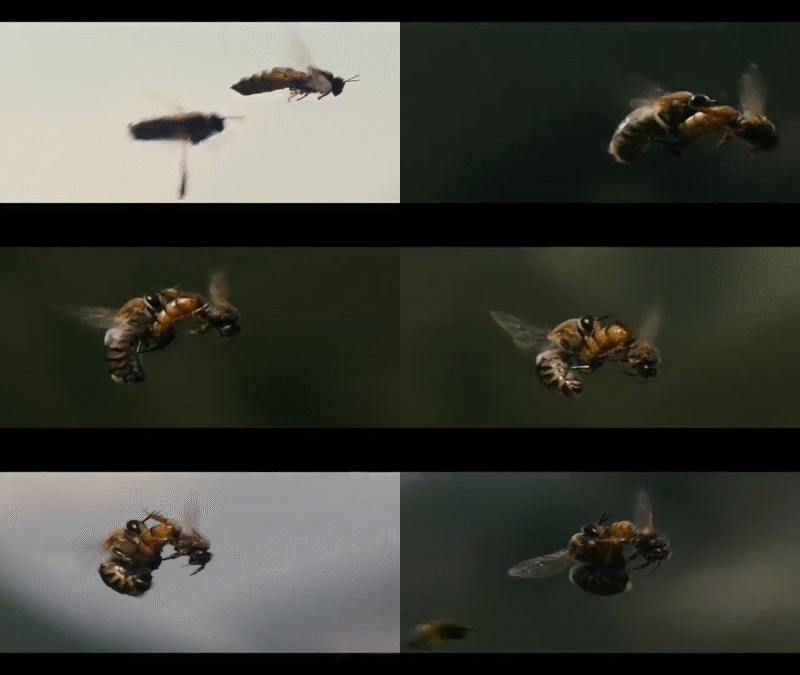
One might assume that asexual reproduction leads to an evolutionary dead end, with the accumulation of deleterious mutations ultimately resulting in species extinction. Recent studies show that this is not the case, and the drone provides a well-studied example. The particular case of reproduction in Varroa destructor is illuminating: these mites exhibit fewer deleterious mutations than other sexually reproducing insects …
Examples of asexual reproduction in certain animals include: the hammerhead shark, the leopard shark, the sawfish, the sea anemone, the Komodo dragon, the gecko, the aphid, the scale insect …
While the vast majority of species use some form of sex to reproduce, several organisms have evolved toward reproduction without sex. For what reasons, and with what consequences? Biologists from the research group of Tanja Schwander, assistant professor at the Department of Ecology and Evolution (DEE) of UNIL, provide different perspectives on this question in the scientific journals «Evolution Letters» and «Nature Communications».
Sexual reproduction combines meiosis—the process of cell division that leads to the production of sex cells—and fertilization. The result is a new individual that possesses 50% of the genes from each of its two parents. However, several organisms have evolved toward reproduction without sex. Vegetative reproduction, for example, involves neither meiosis nor fertilization. The offspring are clones of their parents. Parthenogenesis is another mode of asexual reproduction, in which meiosis sometimes occurs but fertilization does not. The new individual then inherits only the genes of its mother and has no father.
Less costly, simpler, and faster
Although less common, asexual reproduction appears simpler, faster, and less costly than sexual reproduction. Indeed, sexual reproduction requires the participation of two individuals (a male and a female) to accomplish what the female could very well do on her own. The production of males can therefore be seen as a waste of resources, especially in species where only females care for the young. With asexual reproduction, there is no need to spend time and energy finding a suitable sexual partner, and the risks of disease transmission are lower.
So why not clone like sea anemones or reproduce by parthenogenesis like stick insects? “The reasons for the maintenance of sex or for an evolution toward asexual reproduction are still poorly understood today. Sex may offer an advantage because it can generate more genetic diversity than asexual reproduction. Genetic diversity is important when it comes to adapting to a new environment or coping with predators or parasites that adapt to their hosts,” comments Tanja Schwander, assistant professor at the Department of Ecology and Evolution of the Faculty of Biology and Medicine at UNIL. But are these potential advantages sufficient to compensate for the considerable and unavoidable costs of sexual reproduction?
Two articles produced within the research group on the evolution of reproductive and genetic systems led by Tanja Schwander analyze, respectively, the evolution and the consequences of asexual reproduction in animals. Published in the scientific journals Evolution Letters and Nature Communications, they use as models species for which no males are known, but only females.
A favored mode of reproduction in species with large populations
The first article published in Evolution Letters addresses the evolution and maintenance of asexuality in hymenopterans (wasps, bees, and ants) and in thrips (small insects often parasitic on plants). Under the direction of Tanja Schwander, Casper van der Kooi, a doctoral student in the group, and Cyril Matthey-Doret, a master’s student, established and analyzed a database comprising more than 700 asexual species. “This work allowed us to show that this mode of reproduction is very common in certain wasps; in some genera, up to one third of species reproduce exclusively asexually,” notes Casper van der Kooi, first author of the study.
Several ecological traits favor the evolution and persistence of asexual species, notably very broad geographic distributions and ecological niches. “Asexuality could therefore be maintained as a long-term reproductive strategy in species with very large population sizes, which indirectly indicates that the advantages of sex are likely to emerge mainly in populations with relatively few individuals,” analyzes Tanja Schwander.
Fewer deleterious mutations in asexual species
Asexual reproduction is often considered an evolutionary dead end. Indeed, this mode of reproduction is thought to lead, over generations, to an accumulation of deleterious mutations—in other words, to create a disadvantage for the organisms that carry them and to inevitably result in species extinction.
A second article published in Nature Communications, led by Dr. sc. Jens Bast, first assistant in Tanja Schwander’s group, and conducted by doctoral student Alexander Brandt from the group of Professor Stefan Scheu at the University of Göttingen (Germany), shows that this is not necessarily the case. By studying species of oribatid mites, small animals with an apparently strictly asexual mode of reproduction, the consortium was able to demonstrate that these animals have fewer deleterious mutations than their sexually reproducing counterparts.
“These two articles are important because they allow us to better understand one of the major unresolved questions in biology: why is sexual reproduction so common?” concludes Tanja Schwander.
Source: Uni Lausanne
See also:
- Introduction to Bee Genetics
- The Bee Genome
- Fertilised or Unfertilised Egg
- Laying Workers That Rear a New Queen
- DNA Adaptation According to Role